What's in the Water? The Surprising Science Driving America's Most Obsessive Indian Pizza Chefs

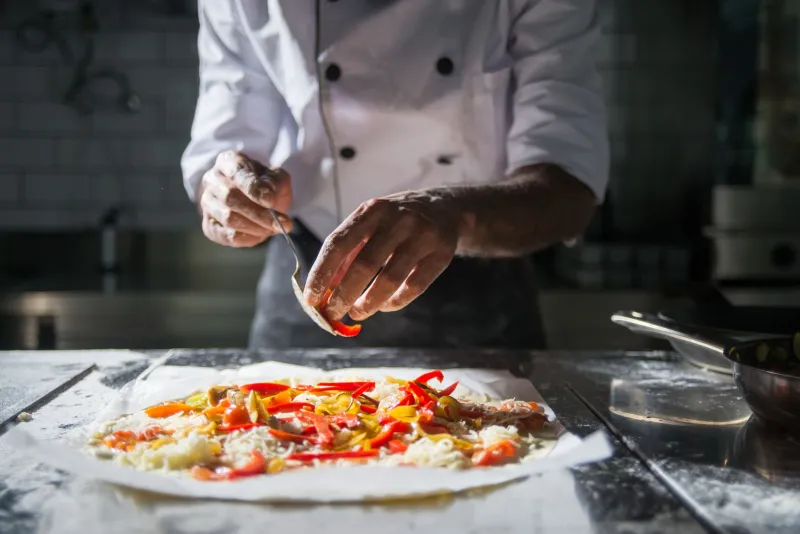
Most people walk into a pizza place thinking about toppings. Maybe they're weighing paneer against pulled tandoori chicken, or wondering whether a tamarind-laced sauce can really hold up under a layer of fresh mozzarella. What almost nobody is thinking about is the water used to make the dough.
That's exactly what a handful of Indian fusion pizza chefs across the country are counting on.
In cities from Portland to Atlanta, a quiet but surprisingly rigorous movement is reshaping how Indian-influenced pizza gets made from the ground up — literally. These chefs are sourcing, testing, and in some cases mineral-adjusting their water supplies to chase something specific: the subtle but real influence that water chemistry has on fermentation, gluten development, and the final texture of a baked crust. And they're drawing their inspiration from an unexpected source — the five great river systems of the Indian subcontinent.
Why Water Chemistry Actually Matters
Here's the short version of the science: water is never just water. Depending on where it comes from, it carries varying concentrations of calcium, magnesium, bicarbonate, sulfate, and other dissolved minerals. Those minerals don't just sit passively in your dough — they interact with yeast, affect how gluten proteins bond, and influence the speed and character of fermentation.
Bakers and brewers have known this for decades. The famous crispness of a Vienna bread crust? Partly the water. The soft, extensible dough behind a classic Neapolitan pizza? Naples' naturally soft water plays a documented role. Hard water tends to tighten gluten and slow fermentation. Soft water does the opposite — it loosens structure and speeds things up.
When you start layering Indian fermentation traditions on top of pizza dough logic, the stakes get even more interesting.
"We're not working with a straight yeast-and-flour situation," explains one chef at an Indian fusion spot in Chicago who asked to be identified only by his first name, Rohan. "A lot of us are using longer cold ferments, sometimes with a touch of yogurt culture or even a fenugreek-based starter. The water you use completely changes how those cultures behave. You get different sour notes, different crust color, different chew."
The Five Rivers as a Flavor Framework
The five rivers that give this site its name — the Jhelum, Chenab, Ravi, Beas, and Sutlej — flow through the Punjab region, one of the most agriculturally rich and culinarily influential areas of South Asia. They're not just geographic landmarks. For chefs who grew up in or studied the food traditions of that region, they represent a kind of sensory baseline: what dough made with that water tastes like, feels like, performs like.
Replicating that in the US isn't straightforward. American municipal water systems vary wildly — Denver's water is notably soft, while Phoenix's is famously hard. Coastal cities often pull from different source profiles than inland ones. That variation, which most restaurants treat as background noise, is something these chefs are starting to treat as a variable worth controlling.
A chef in Houston named Priya has been experimenting with water adjustment for about two years. She started by ordering basic water testing kits, then moved on to working with a local brewing supply shop — the craft beer world has been doing this kind of mineral adjustment for years — to dial in specific hardness levels for her dough batches.
"Houston water is pretty hard," she says. "Great for some things, but it was making our crust tighter than I wanted. I was going for something closer to what you'd get from a slower, softer ferment — the kind of dough that has a little give to it, almost like a good paratha has give. I had to soften the water down and add a small amount of magnesium back in at a specific ratio. It took months to get right."
The results, she says, are subtle enough that most customers can't name what's different — but noticeable enough that her regulars keep coming back specifically for the crust.
Regional Water, Regional Identity
What's fascinating about this trend is that it's not pushing toward uniformity. These chefs aren't all trying to make the same dough. They're using their local water as a starting point and adjusting from there, which means the Indian pizza coming out of a Portland kitchen is going to have a genuinely different character than what's being made in Miami — even if both chefs are working from the same philosophical framework.
That's actually very Indian, when you think about it. The subcontinent's food traditions have always been intensely regional, shaped by local geography, climate, and yes, water. The idea that a pizza in one American city should taste exactly like a pizza in another city is a very Western assumption. Indian culinary logic says: your location shapes your food. Lean into it.
A chef in Seattle named Dev has taken this philosophy further than most. He sources water from three different Pacific Northwest springs, blends them to hit a specific mineral target, and adjusts seasonally based on how his sourdough-adjacent starter is behaving. "In winter, my starter runs slower," he explains. "I compensate partly with water temperature, but also by softening the mineral profile a bit. It sounds obsessive, and it is. But the crust we're getting right now is the best we've ever made."
Does It Actually Show Up on the Plate?
Fair question. And the honest answer is: yes, but not in ways that are easy to point to.
You're not going to bite into a slice and think, "ah, the bicarbonate content is clearly optimized here." What you might notice is that the crust has an unusually open, airy crumb structure despite being thin. Or that there's a faint tang that plays well against the richness of a butter chicken sauce without tipping into sourness. Or that the char on the bottom is even and deep rather than patchy.
These are the kinds of details that separate a good pizza from a great one — and they're the kinds of details that are almost impossible to achieve consistently without controlling your inputs.
For Indian fusion pizza specifically, where you're already asking a lot of the dough — it needs to hold up to wetter, more aromatic sauces, it needs to complement rather than compete with bold spice profiles, it needs to have enough structural integrity to carry heavier toppings like paneer or slow-cooked lamb — getting the water right isn't a gimmick. It's craft.
The Takeaway for Diners
You don't need to become a water chemist to appreciate what's happening here. But the next time you're eating a really exceptional Indian pizza and you can't quite figure out why the crust is so good, consider asking your server whether the kitchen has done anything unusual with their dough process.
There's a decent chance the answer involves a conversation about minerals.
The chefs chasing this level of detail aren't doing it for the Instagram story. They're doing it because they believe Indian fusion pizza deserves the same obsessive craft attention that any serious cuisine gets. And they're right.
Water, it turns out, is where that obsession begins.